FUDA  ROOFING
ROOFING
+86 138 6922 6336
Watch Factory
ROOFING
Stone coated metal roof tiles look like traditional clay or slate tiles, but they are actually a multi-layer engineered product — a galvanized steel core coated in stone granules and sealed with an acrylic glaze. Understanding how these tiles are made is the single best way to judge whether a manufacturer's product will last 20 years or fail in 5. Here is the complete manufacturing process, step by step, so you know exactly what to look for when sourcing.
Every stone coated metal roof tile starts as a coil of steel. The most important specification at this stage is the coating alloy on the steel surface:
The base steel thickness typically ranges from 0.35 mm to 0.45 mm. Thinner steel is cheaper but dents more easily and gives less time before any corrosion reaches the structural core. For demanding projects, spec the thicker end of the range.
What to ask a supplier: "What steel coating do you use — AZ150 galvalume or standard galvanized?" A clear, immediate answer of "AZ150" is a strong quality signal. Vague answers usually mean standard galvanized.
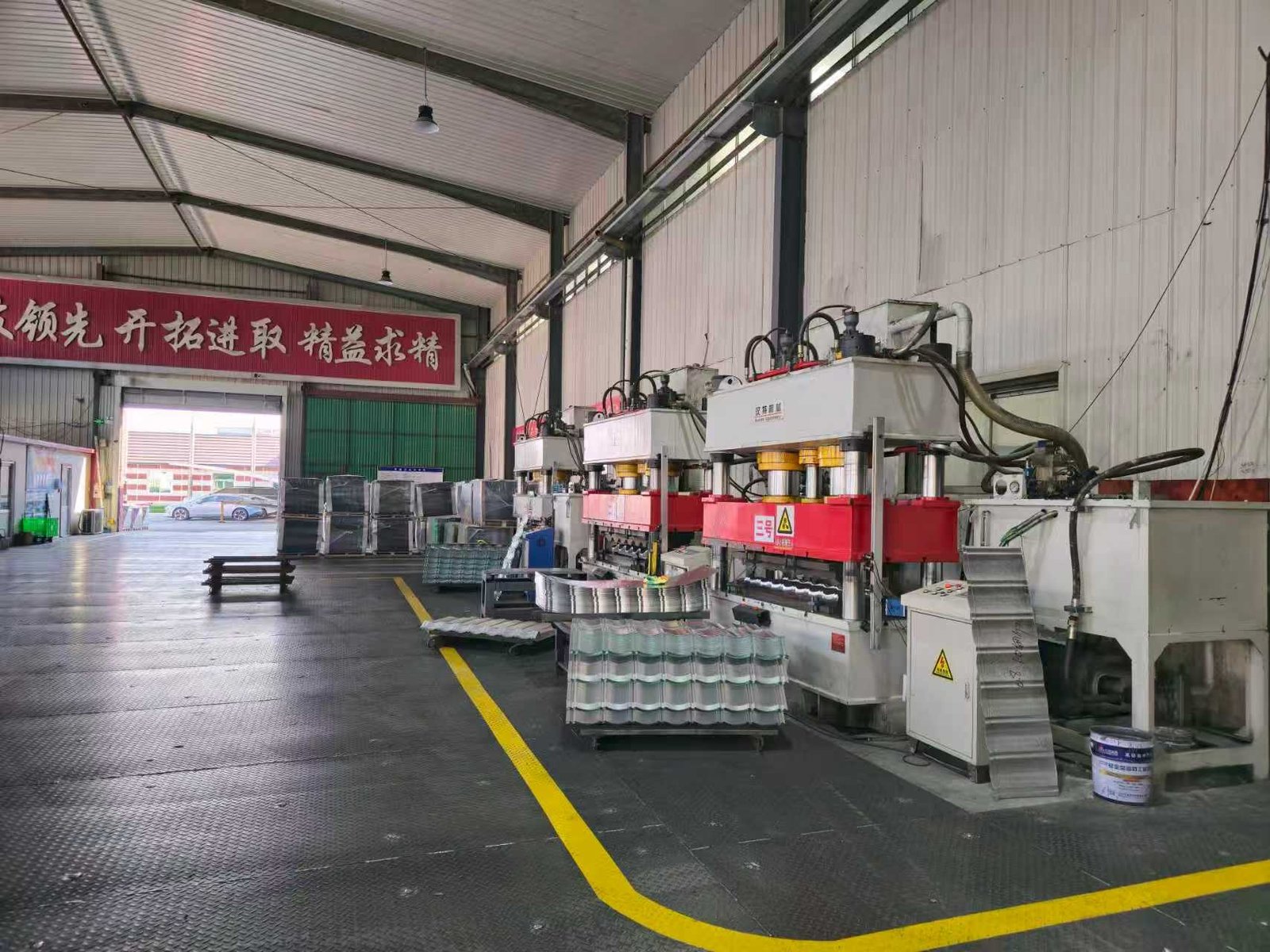
The coated steel coil is fed through a series of rollers that progressively bend it into the final tile shape. This is what gives stone coated tiles their distinctive profiles — whether a flat shingle look, a high-wave Roman tile, or a wood-grain texture.
The roll-forming stage determines two things that matter a great deal on a real roof:
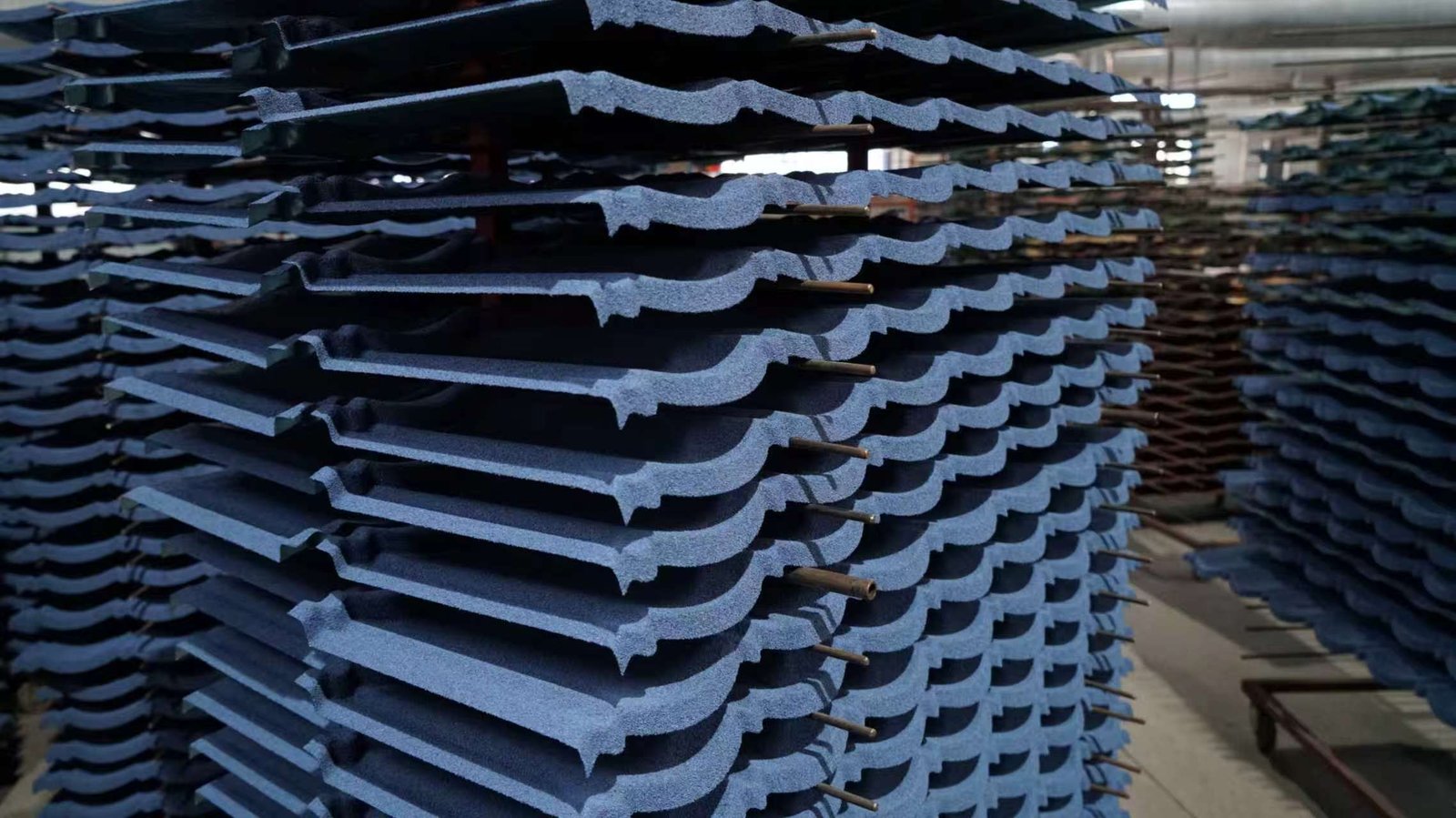
This is the step that gives the product its name and its look. After forming, the steel tile is coated with a layer of acrylic resin, then natural stone granules (typically crushed basalt or silica) are applied while the resin is still wet.
The stone granules serve three functions at once:
The quality and consistency of the stone granules matter. Uniform granule size produces even color and coverage; irregular or undersized granules leave thin patches where the resin and steel are exposed.
After the granules are applied, the tile passes through a curing oven. Heat sets the acrylic resin so the stone granules are permanently bonded to the steel. Proper curing is what prevents granule loss — the "bald spots" you sometimes see on low-quality tiles after a few seasons of rain and sun.
Under-cured resin means granules begin washing off within the first few years. A properly cured tile holds its granules for decades.
Once cured, many manufacturers apply a clear, UV-resistant acrylic overglaze. This seals the stone granules, prevents moisture from working its way between granules, and adds a second layer of UV protection. It also gives the tile a subtle sheen and makes the color look richer.
This step is sometimes skipped to cut costs — a tile without overglaze will fade and chalk noticeably faster.
Finally, tiles are cut to final length, inspected, and packed for shipping. Quality manufacturers pack tiles so they can survive container transport to another continent without scratching or bending — the packaging itself is a quality indicator you can see before the product even arrives.
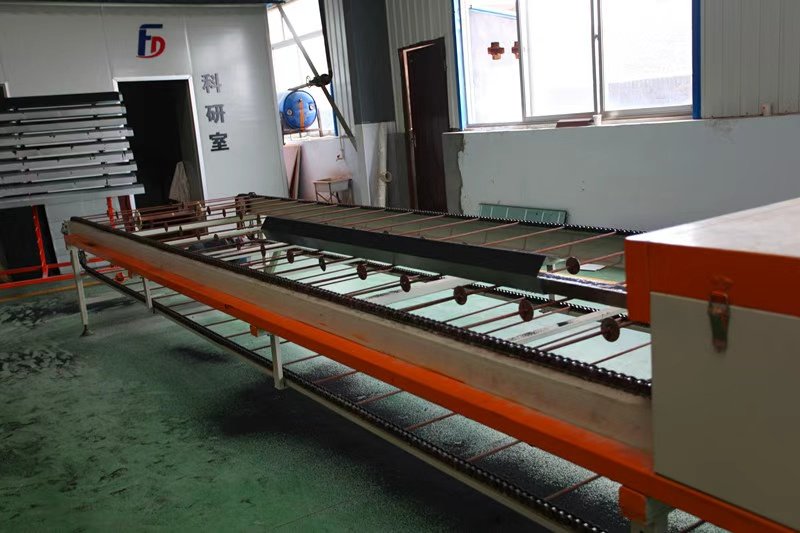
A reputable manufacturer runs quality checks at every step, not just at the end. Here is what a proper QC process looks like:
| Stage | What Is Checked |
|---|---|
| Incoming steel coil | Coating alloy (AZ150 vs galvanized), coating weight, base thickness, coil width |
| Roll forming | Profile dimensions, interlocking fit, straightness, absence of cracks at bend points |
| Stone coating | Granule coverage uniformity, resin adhesion, color consistency between batches |
| Curing | Adhesion tests (tape-pull / rub tests) to confirm granules are fully bonded |
| Finished product | Final dimensions, surface defects, color match to approved sample, packaging integrity |
Every durability claim a stone coated metal roof tile makes — 30, 40, or 50 years — traces back to decisions made on the factory floor:
| Manufacturing Choice | Result If Done Well | Result If Cut Short |
|---|---|---|
| AZ150 galvalume vs galvanized | Decades of corrosion resistance | Rust at edges and scratches within years |
| Proper curing | Granules stay bonded for the tile's life | Granule loss, bald patches, exposed resin |
| UV-stable overglaze | Color holds with minimal fading | Chalking and color fade within a few years |
| Consistent granule sizing | Even, attractive, well-covered surface | Patchy color and thin spots that expose the base |
A serious manufacturer provides a spec sheet naming the steel substrate (AZ150 galvalume), base thickness, coating type, and granule source. If the data sheet is vague or missing, treat it as a warning sign.
A sample tells you in 30 seconds what a data sheet can't: granule uniformity, color richness, edge finish, and the feel of the overglaze. Bend it, scratch it lightly, and look at the cut edge to see the steel coating. Fuda Roofing provides free samples for qualified projects.
Reputable manufacturers are happy to show their production line, whether through a factory tour video or a live visit. A reluctance to show the factory is often a reluctance to show the quality control (or lack of it).
Fuda Roofing manufactures nine tile profiles in-house with AZ150 galvalume steel and full quality control. Request a free sample and technical data sheet to see the manufacturing quality for yourself.
Request Free Sample & Quote →Q: What steel is used in stone coated metal roof tiles?
A: Quality tiles use AZ150 galvalume steel — an aluminum-zinc alloy coating at roughly 150 g/m² — on a base 0.35–0.45 mm thick. The aluminum in the alloy forms a passive barrier against corrosion, and the zinc protects cut edges. Cheaper tiles use standard galvanized steel, which corrodes faster.
Q: Are the stone granules real stone?
A: Yes. The coating uses natural crushed stone — typically basalt or silica — bonded to the steel with acrylic resin. The mineral granules are what give the tile its traditional look and its UV protection.
Q: How long does a stone coated metal roof tile last?
A: A well-made tile from AZ150 galvalume steel with proper curing and a UV-stable overglaze is engineered for a multi-decade service life, commonly cited in the 40–50 year range when correctly installed. Lifespan ultimately depends on the manufacturing choices described above plus installation quality.
Q: What is the difference between a cheap and an expensive stone coated tile?
A: It almost always comes down to the substrate (galvanized vs AZ150 galvalume), base steel thickness, granule quality and uniformity, curing time, and whether a UV overglaze is applied. These are invisible at first but determine whether the roof still looks good in year 15.
Q: How do I verify a manufacturer's quality claims?
A: Request the technical data sheet, ask for a physical sample to inspect, and — for large orders — consider a third-party factory inspection or a live factory tour. A transparent manufacturer will accommodate all three.
Stone coated metal roof tiles are a layered engineered product, and their performance is decided on the factory floor. The substrate (AZ150 galvalume steel), the roll-formed profile, the stone granule coating, the curing process, and the overglaze each contribute to how the tile looks and how long it lasts. Understanding this process gives you a concrete checklist for evaluating any supplier — and it is the difference between a roof that lasts decades and one that fades, rusts, and loses its granules in a few years. When you source, demand the data sheet, hold a sample in your hands, and work with a manufacturer that is proud to show you how the tiles are made.
彩石金属瓦并非天然石材,而是一种多层复合的工程产品——以镀铝锌钢板为基材,表面经丙烯酸树脂粘附天然石粒,再以UV保护釉层密封。本文完整拆解了彩石金属瓦的生产工艺:从AZ150镀铝锌钢卷的选材、辊压成型塑造瓦型、石粒涂层赋予外观与防护、高温固化确保石粒牢固附着,到出厂前的多道质量检验。文中说明了每个环节对产品寿命的影响——基材等级、固化程度、釉层有无、石粒均匀度,正是优质瓦与劣质瓦之间"看不出来但几年后见分晓"的差别。对于正在采购彩石金属瓦的进口商、承包商和项目开发商,这篇文章提供了一份实用的供应商评估清单:索取技术数据表、检查实物样品、并选择愿意展示生产线的制造商。了解生产工艺,是判断一家工厂产品能否真正耐用几十年的最佳途径。
Written by: Fuda Roofing Export Team · Last updated: 2026-09-21